
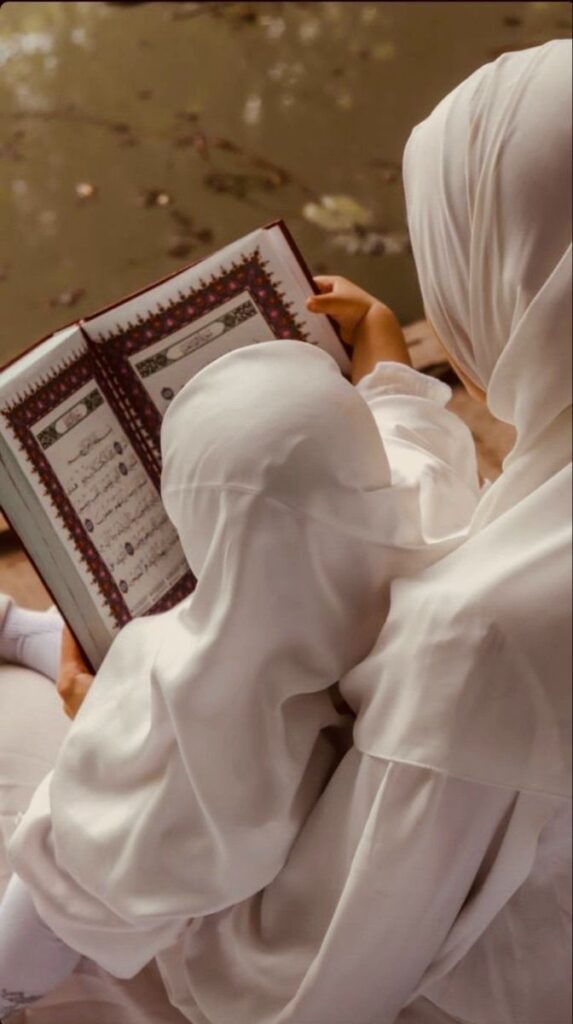
In the Light of the Wisdom Allah Granted to Luqmān
In Islam, a child is not merely an additional member of the family. Nor is he or she simply an emotional extension of the couple. A child is an amānah — a trust entrusted by Allah — an immense responsibility, but also a source of spiritual elevation.
The Qur’an reminds the believers:
“O you who have believed, protect yourselves and your families from a Fire whose fuel is people and stones, over which are angels, harsh and severe, who do not disobey Allah in what He commands them but do what they are commanded.” (Surat At-Taḥrīm, 66:6)
This verse immediately places the family at the heart of religious responsibility. It is not merely about providing materially for one’s children, but about protecting them spiritually. The exegetes explain that “protecting one’s family” means teaching them the religion, educating them, and guiding them toward obedience to Allah.
Thus, education in Islam does not begin at school. It begins in the consciousness of the parents, in their supplications, in their behavior, and in their own religious practice. A child absorbs the spiritual atmosphere of the home long before understanding words.
I/ The Child as a Continuing Deed
The role of a child extends beyond the family unit. It is directly connected to the Hereafter of the parents.
The Prophet ﷺ said:
“When the son of Adam dies, his deeds come to an end except for three: ongoing charity, beneficial knowledge, and a righteous child who prays for him.” – Riyāḍ as-Ṣāliḥīn, Hadith 1383, reported by Muslim
This hadith clearly establishes that a righteous child is among the enduring deeds of a believer. The child becomes a reflection of the education received. He or she is both a responsibility and a spiritual extension.
This means parents will be questioned about how they fulfilled this trust. Education is therefore not a cultural or social option — it is a religious obligation.
II/ Luqmān: A Model of Parental Education
In Surat Luqmān (31:12–19), Allah conveys to us the intimate dialogue between a father and his son. This passage is of exceptional educational richness. It is not merely a story, but a divine methodology of transmission.
Gratitude
Education begins with gratitude. Allah says:
“And We had certainly given Luqmān wisdom, [saying], ‘Be grateful to Allah. And whoever is grateful is grateful only for [the benefit of] himself. And whoever denies [His favor] — then indeed, Allah is Free of need and Praiseworthy.’” (Verse 12)
Before Luqmān even addresses his son, he is described as a grateful man. This shows that gratitude is the foundation of sound education. A child raised in an atmosphere of gratitude naturally learns to recognize Allah’s blessings and to avoid constant complaint. Placing gratitude at the center of education forms a peaceful and confident heart.
Tawhid
Then comes the absolute foundation: Tawḥīd. Luqmān says to his son:
“O my son, do not associate anything with Allah. Indeed, associating partners with Him is a great ظلم (injustice).” (Verse 13)
The first thing to instill in a child is not a social rule or academic success, but awareness of Allah’s Oneness. Faith precedes everything. Building a child upon sound belief gives him or her a compass for life.
The Importance of the Mother
In the same passage, Allah reminds us of the central role of the mother:
“And We have enjoined upon man goodness to his parents. His mother carried him in weakness upon weakness, and his weaning is in two years. Be grateful to Me and to your parents. To Me is the final destination.” (Verse 14)
This reminder is not incidental. It embeds gratitude toward parents — especially the mother — within education. Pregnancy, childbirth, and nursing are mentioned to awaken deep respect and conscious gratitude in the child. Honoring the mother is an act of obedience to Allah.
Awareness of Allah’s Omniscience
Luqmān also teaches awareness of divine omniscience. He says:
“O my son, indeed if it be [the weight of] a mustard seed and should be within a rock or in the heavens or in the earth, Allah will bring it forth. Indeed, Allah is Subtle and All-Aware.” (Verse 16)
This powerful image instills in the child the certainty that no action — however small or hidden — escapes Allah’s knowledge. Islamic education develops inner consciousness. The child behaves correctly not out of fear of people, but out of awareness of Allah.
Prayer and Patience in Trials
After anchoring belief in his son’s heart, Luqmān naturally moves to practice. Faith is not theoretical; it manifests in action. He says:
“O my son, establish prayer, enjoin what is right, forbid what is wrong, and be patient over what befalls you. Indeed, that is among the matters requiring determination.”(Verse 17)
Prayer appears here as the first concrete pillar of faith. It structures the day, disciplines the soul, and maintains a constant connection with the Creator. Balanced religious education cannot neglect the gradual and serious teaching of ṣalāh, for it shapes the child’s spiritual identity.
But Luqmān does not limit himself to ritual acts. He prepares his son for life’s realities. By linking prayer with commanding good, forbidding evil, and patience, he shows that authentic faith requires engagement and endurance. The believing child will face trials and opposition. Therefore, ṣabr (patience) becomes an essential component of education.
Raising a child according to the Islamic perspective does not mean shielding them from every hardship, but teaching them to navigate difficulties with dignity, perseverance, and trust in Allah.
Good Character and Modesty
Luqmān’s education also extends to social behavior. He warns against arrogance:
“And do not turn your cheek [in contempt] toward people, nor walk through the earth exultantly. Indeed, Allah does not like the self-deluded and boastful.”(Verse 18)
Modesty in behavior and attitude is a sign of nobility. A child must understand that true value lies not in appearance or displayed superiority, but in humility.
Finally, Luqmān addresses speech:
“And be moderate in your pace and lower your voice; indeed, the most unpleasant of sounds is the voice of donkeys.”(Verse 19)
This strong comparison teaches control of tone and gentleness in speech. Raising one’s voice, shouting, or humiliating others contradicts Islamic ethics. Speech is an integral part of moral education.
Through just a few verses, Allah provides a complete educational program: gratitude, pure faith, respect for parents, awareness of Allah, prayer, patience, humility, and gentleness. Education according to Luqmān is holistic. It shapes the heart, mind, and behavior. The role of parents is not merely to teach rules, but to build consciences.
III/ The Child as a Trial and a Mercy
The Qur’an also reminds us:
“Your wealth and your children are but a trial…” (Surat At-Taghābun, 64:15)
Children can become a distraction from the remembrance of Allah if spiritual priorities are not maintained. Yet this trial is also an opportunity for elevation. Through them, Allah teaches patience, gentleness, and self-control.
The Prophet ﷺ embodied this pedagogy through his example. He played with children, prolonged his prostration when his grandson climbed on his back, and openly showed affection. His conduct demonstrates that tenderness is an integral part of Islamic education.
IV/ A Comprehensive Responsibility
The role of children in Islam directly involves their parents. Prayer must be taught gradually, and seriously by the age of ten as indicated in the hadith. Food, clothing, moral environment, and consumption choices — all contribute to spiritual development.
Children learn more through imitation than through speeches. A home where prayer is alive, where supplications are recited aloud, and where gratitude is constant naturally forms a heart attached to Allah.
Education begins with transmitting the knowledge we already possess. Even modest knowledge, conveyed sincerely, is better than complete delegation to institutions. The home remains the first school.
V/ The Child and the Community
In Islam, education is not only about individual interest. A strong family builds a strong society. Supplications for one’s own children should expand to include the entire community.
Raising a believing, balanced, grateful, and responsible child contributes to the stability of the Ummah. Each household becomes a pillar.
Thus, the role of children in Islam is multifaceted: they are an amānah, a trial, a source of mercy, a continuing deed, and a means of elevation for their parents.
Educating them is not only preparing them for this world. It is preparing them — and preparing ourselves alongside them — to meet Allah.
Nous demandons à Allah qu’Il nous enseigne ce qui nous est utile, qu’Il nous fasse profiter de ce qu’Il nous a enseigné et qu’Il augmente notre science.
Toute justesse provient de Lui.
Et Allah est plus Savant.