
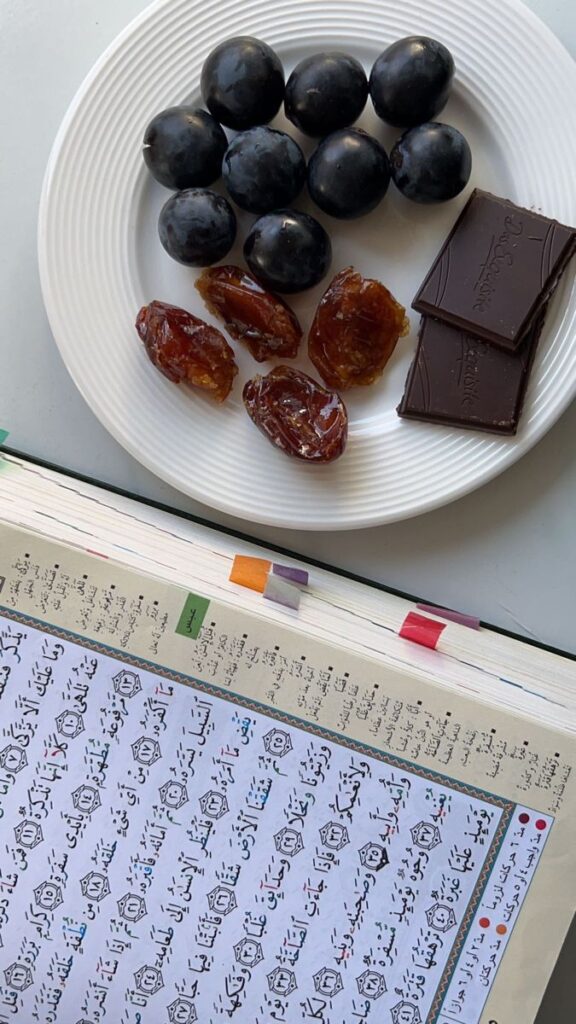
Study of verses 168 and 172 of Surah Al-Baqara
Through verses 168 and 172 of Surat Al-Baqarah, Allah establishes a framework that connects consumption, inner discipline, and taqwa (piety). These verses are not merely about nutrition; they address moral responsibility, purity of sustenance, and consistency between our faith and our actions.
In a context where consumption is excessive, rapid, and often unreflective, it is necessary — as a believing community — to return to these foundations.
I/ Verse 168: A Universal Framework
Allah says:
“O mankind, eat from whatever is on earth that is lawful (halal) and pure (tayyib), and do not follow the footsteps of Shaytan. Indeed, he is to you a clear enemy.” (Surah Al-Baqarah, 2:168)
This verse addresses all of humanity, not only Muslims. This shows that the question of dietary guidelines concerns any organized society. Human beings need rules to structure both their individual and collective lives.
Two key concepts appear in this verse:
Halal: what is legally permissible according to Islamic law.
Tayyib: what is good, wholesome, pure, and beneficial.
Halal represents the minimum requirement — respecting the prohibitions and obligations set by Allah. Tayyib introduces a qualitative dimension: seeking what is healthy, balanced, and morally sound.
The verse also warns against “following the footsteps of Shaytan.” The exegetes explain that this may include:
Inventing prohibitions that Allah did not reveal
Exaggeration in religious practice.
Carelessness that leads to disobedience.
Thus, Islam establishes a balance between strictness and ease.
II/ The Link Between Food and the Acceptance of Supplication
A hadith reported by Abu Hurayrah and authenticated in Sahih Muslim (no. 1015) clearly illustrates the connection between consumption and spirituality.
The Prophet ﷺ mentioned a man traveling — a situation favorable for the acceptance of supplication. He raises his hands to the sky and calls upon Allah insistently. However, the Prophet ﷺ explains that his food, his drink, and his wealth are unlawful. He then concludes: “So how can he be answered?”
This hadith shows that unlawful consumption can become an obstacle to the acceptance of supplications. Food directly influences the believer’s relationship with Allah. The purity required in acts of worship is not limited to intention; it also includes the source of our wealth and sustenance.
The Prophet ﷺ deliberately describes a context conducive to answered supplication: the man is traveling, in a humble state (dusty and disheveled). All external elements seem present.
Yet one obstacle remains: the source of his sustenance.
The Prophet ﷺ mentions four elements: his food is unlawful, his drink is unlawful, his clothing is unlawful, and he has been nourished by the unlawful. This is not an isolated act but a lasting condition. The unlawful has permeated his life.
Scholars explain that unlawful consumption can become a veil between the servant and his Lord. This does not necessarily mean that supplication is absolutely rejected — for Allah is Wise — but it constitutes a major obstacle.
This teaches us that coherence between our actions and our supplications is essential. We cannot hope for closeness to Allah while neglecting the limits He has set.
This hadith calls for introspection. It does not concern only obvious major prohibitions. It pushes us to question: The source of our income, Our business practices, Our compromises, Our possible negligence in this area…
Taqwa in food goes beyond simply eating halal meat. It includes the overall purity of sustenance.
Ibn Rajab رحمه الله explains that purity of means influences the light of the heart and sweetness in worship. Conversely, unlawful consumption hardens the heart and weighs down the soul.
III/ Verse 172: A Specific Requirement for Believers
In this verse, Allah no longer explicitly mentions halal, but only tayyibat (the good and pure things).
Allah says:
“O you who believe, eat from the good things We have provided for you and be grateful to Allah, if it is indeed Him that you worship.”(Surat Al-Baqarah, 2:172)
Unlike verse 168, which addressed all humanity, this verse begins with: “O you who believe.” This is a particular call that indicates a higher level of expectation.
Scholars explain that for the believer, observing halal is presumed. He or she no longer remains at the minimum legal level. The believer’s horizon is excellence. The believer does not merely avoid the forbidden; he seeks to purify his habits.
This implies:
Choosing what benefits the body.
Avoiding what harms health or balance.
Protecting oneself from excess.
Rejecting negligence.
The shift from halal to tayyib marks the transition from simple rule compliance to the pursuit of spiritual quality.
Allah reminds us that these provisions have been granted to us. Nothing is acquired purely by our own ability. Our sustenance is a gift. This reorients our perspective: food is not merely a consumer product, but a divine blessing. Awareness of this transforms the act of eating from automatic to conscious.
The verse concludes:
“And be grateful to Allah, if it is Him that you worship.”
Gratitude is not presented as a simple moral addition, but as proof of sincerity in worship.
Thanking Allah in food means: Saying His Name before eating, internally recognizing the source of the blessing, avoiding waste, not despising food, using the strength gained to obey Allah.
Eating can thus become an act of worship in itself. Intention plays a central role. If we eat to preserve our strength in order to worship Allah, the act becomes rewarded.
The verse invites us to move beyond mechanical consumption.
It pushes us to ask: Do we eat out of need or habit? Do we seek quality or quantity?Are we grateful or distracted?
IV/ Food and the Purification of the Heart
In Islam, the heart (qalb) occupies a central place. The Prophet ﷺ said:
“Indeed, in the body there is a piece of flesh; if it is sound, the whole body is sound, and if it is corrupted, the whole body is corrupted. Truly, it is the heart.”(Reported by Al-Bukhari and Muslim)
The heart is the seat of intention, sincerity, and awareness of Allah. It is influenced by our repeated choices, even those that seem trivial. Food is a daily act. Precisely because it is repeated, it has a formative impact.
Excessive, disordered consumption — or consumption driven solely by desire — can train the soul toward constant indulgence. The individual gradually loses self-mastery. Conversely, consumption governed by principles develops restraint, discipline, and awareness.
The link between food and spirituality is not theoretical. Scholars often mentioned that excess burdens the body and weakens concentration in worship. Moderation, on the other hand, fosters clarity and inner vigilance.
Taqwa implies respecting the limits set by Allah and mastering desires. In food, this means we do not eat merely because we crave, but because it is beneficial and measured.
Food becomes a training ground. Each choice is an opportunity to practice restraint. Saying “no” to excess is a form of spiritual discipline.
Our plate thus becomes a space for educating the heart. We learn to control impulses, respect limits, and cultivate gratitude.
V/ Contemporary Application of the Concept of Tayyib
We live in a society of rapid and abundant consumption. Products are constantly accessible. The offer is vast, temptations are numerous.
In this context, the notion of tayyib takes on a broader dimension. The believer does not limit himself to verifying whether something is legally halal.
He also asks: Is it truly beneficial? Is it consumed in moderation? Is it aligned with an ethic of responsibility?
Tayyib implies comprehensive awareness.
It includes attention to product quality, avoidance of food negligence, and moderation in quantity. Excess — even in what is lawful — can become blameworthy. The Qur’an reminds us elsewhere:
“Eat and drink, but do not be excessive.” (Surat Al-A‘raf, 7:31)
Overconsumption weakens personal discipline and distracts from meaning.
In our time, reflecting on tayyib may also include:
Thinking about methods of production.
Being mindful of waste.
Acting responsibly toward resources.
Waste contradicts gratitude. Abundance should not lead to carelessness. The believer seeks coherence between faith and lifestyle.
He does not ask only: “Is it permissible?”
But also: “Is it beneficial?” “Is it measured?” “Is it in harmony with the spirit of taqwa?”
Ainsi, il ne se demande pas uniquement : « Est-ce permis ? » Mais aussi : « Est-ce bénéfique ? » « Est-ce mesuré ? » « Est-ce conforme à l’esprit de la taqwa ? »
We ask Allah to teach us what benefits us, to allow us to benefit from what He has taught us, and to increase us in knowledge.
All correctness comes from Him.
And Allah knows best.